Job Fit Analysis: What Actually Happens When You Paste That Job Link
12 August 2026 · Graeme Goulden
Hike Product Blog · Issue 002
You find a job and it's looking pretty good. The title, the company, maybe even the salary range so you spend ten minutes on the description. You think: I could do this. Then you spend two hours rewriting your CV, write a cover letter, apply, and hear nothing.
That cycle; the hours of effort with no signal, no feedback, no idea if you were ever actually a realistic candidate is what Job Fit is built to break. You'll have seen plenty of posts about this topic coming from us recently so we wanted to tell you about what happens when you actually do that analysis.
Here's exactly what happens when you paste a job link into Hike.
Step 1: We Read the Role the Way a Hiring Manager Does
The moment you submit a job URL or paste a job description, Hike's analysis engine pulls apart the role at multiple levels.
It's actively identifying what the role is really asking for: the explicit requirements (years of experience, tools, qualifications), the implicit requirements (seniority signals, sector fluency, management expectations), the cultural markers embedded in the language, and the salary range if disclosed.
This structured understanding of the role is what everything else is measured against.
Step 2: Your Profile Meets the Role
Your CV, Evidence Bank, and profile are the other side of the equation. Hike maps what you've done. Your roles, your evidence, your stated skills and preferences are all measured against the decoded job requirements.
This produces a Fit Score: a percentage that reflects how closely your current profile matches what the role is genuinely looking for. The score isn't a vanity metric. A 73% fit means there are meaningful gaps, a 91% fit means you're a very strong candidate on paper. The number is calibrated against what hiring managers actually prioritise, not keyword frequency.
What the score tells you
What the score tells you
- Strong Fit (80%+): Your profile is competitive. Apply with confidence.
- Good Fit (60–79%): You have a real case to make, but it needs articulating.
- Developing Fit (40–59%): There are gaps. Some may be bridgeable; some may not.
- Low Fit (below 40%): Worth understanding why before investing time in an application.
Step 3: Strengths and Gaps — With Evidence
The fit score is just the headline. The real value is in what sits underneath it.
Hike breaks your fit into distinct areas; skills, experience level, sector, cultural alignment and shows you exactly where you're strong and where you're thin. Crucially, it maps this back to your actual evidence: which specific achievements or experiences are carrying your case, and which areas have little to back them up.
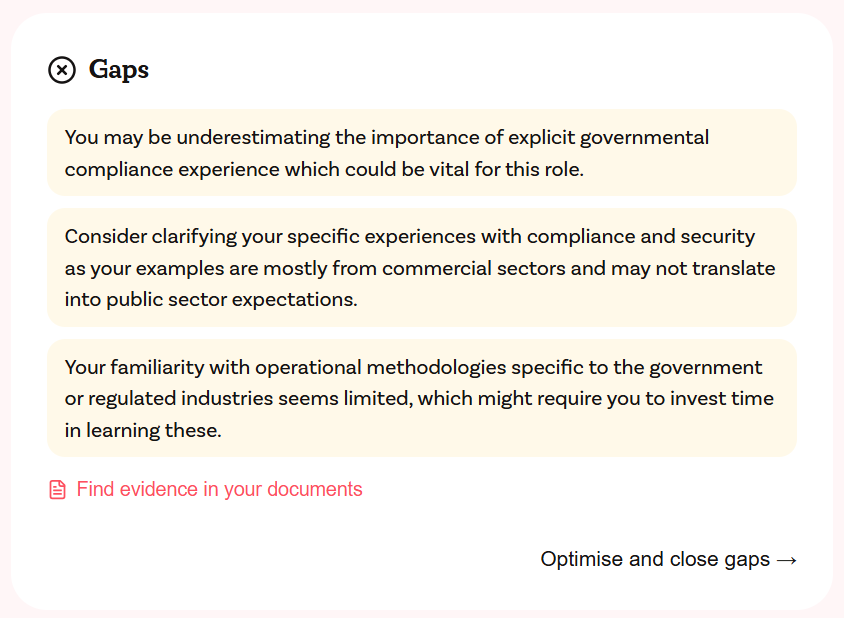
This matters because you can't brief a hiring manager on something you haven't articulated yet. The gaps aren't just technical, they're a narrative too, and Hike shows you both. We show you both because we aren't driven by getting any candidate into any job as a numbers game. We're pretty happy about that and we think we're fairly unique in that space.
Step 4: A Targeted CV, Built for This Role
Here's where most tools stop. We don't.
Once the analysis is complete, Hike generates optimisations for your CV based on your profile and your actual experience, tailored specifically for this role. It reorders emphasis, reframes language, and draws on your Evidence Bank to surface the most relevant material for what this employer is looking for.
We say "optimised" because it's pulling out experience, skills and qualifications you might have missed or didn't think were relevant. We're not inventing a new version of you to get you through an initial screener, because what's the point?
Think of it as the same groundwork a good career coach would do with your CV before a specific application, except it takes seconds, not sessions.
The optimisations are downloadable as a Word document or can be copied straight out of Hike. From there it's up to you to edit, refine, and use responsibly.
Step 5: Bias Check
One of the less visible, but increasingly important, parts of Job Fit Analysis is what happens to the language in your materials.
A Stanford HAI study published this year followed 3.4 million real applicants across 4 million job applications to 1,700 postings, and found that AI hiring tools discriminated against Black applicants in 26% of cases and Asian applicants in 15%. With around 90% of US employers now using AI screening tools, and most of them relying on the same handful of vendors, that bias doesn't stay contained to one company. It spreads across the whole hiring market.
The bias often lives in the language: coded terms that signal protected characteristics, phrasing that triggers algorithmic or human bias, markers that have nothing to do with capability.
Hike's bias check scans your targeted CV for these signals and flags them. Where possible, it shows you how to reframe the language without losing the underlying truth of your experience. The goal is to make sure the version of you that reaches a hiring manager is judged on what you can do, not who you are.
There's a whole blog post on our bias monitoring approach coming up. This was the first service we built on Hike, before the front end was even put together, and we've been working with the University of Manchester on how bias in AI and recruiting manifests so we can stay as well equipped as possible here. If you ever spot an issue, we're watching for it and always reachable at hello@byhike.com.
Step 6: Virtual Hiring Manager
Once you have a fit score and a targeted CV, Hike generates a set of Virtual Hiring Manager questions: the questions a real hiring manager for this specific role would likely ask.
These aren't generic interview questions. They're derived from the role description, the company context, and the gaps in your fit profile. If your fit score reveals a weakness in P&L experience for a Director-level finance role, that's where the hardest VHM questions will come from. (And if you want to know why we built this, just check out Dave.)
Use them to prepare, to pressure-test your evidence, or to decide whether the gaps are things you can genuinely address before interview.
Why It's Worth Running on Every Role You're Serious About
The most common feedback we hear from Hike users is some version of: "I wish I'd done this before I applied."
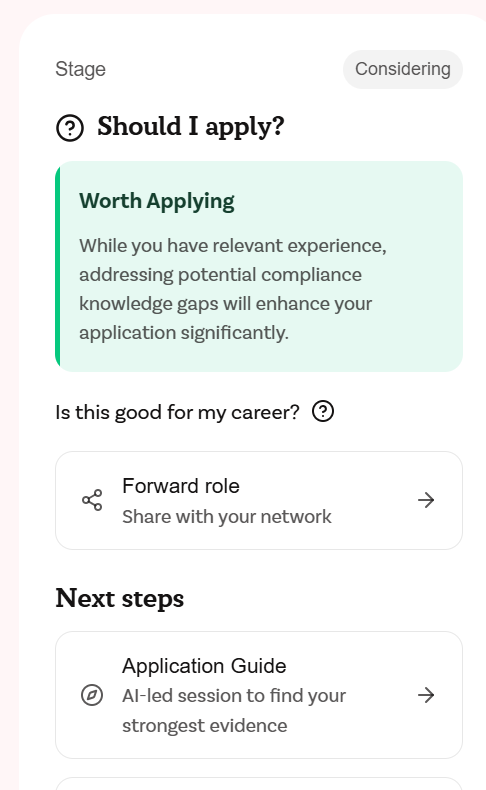
Job Fit Analysis takes about 60 seconds and in that time, it gives you something the application process almost never gives you: signal. Am I a realistic candidate? What's my strongest case? What do I need to address? What will they ask me about?
That signal is worth more than two hours of CV rewriting based on nothing.
A Note on Token Maxing
We've built strict gates into Job Fit Analysis so the output is always honest. If your profile doesn't have enough substance to make a credible case, Hike won't generate content (whether that's a CV or any of the optimisations) that invent it. The minimum evidence threshold exists because a CV that overstates your fit doesn't help you - it sets you up for a harder interview and a worse outcome.
The goal is always to put the strongest true version of you forward. Not to get you into a room you're not ready for.
We're here to support people so that nobody gets left behind. Join us.
And if you want to join the debate on all of this, we've just spun up our Discord server. Feel free to drop in and get some support from your peers and the Hike team.