What Your Rejection Is Actually Telling You (And Why You're Not Hearing It)
19 August 2026 · Graeme Goulden
Hike Product Blog · Issue 003
53% of job seekers were ghosted in 2024 - according to data by Criteria and iHire
Of those who did receive a rejection, the vast majority received some version of: "We've decided to proceed with other candidates whose experience more closely matches our requirements." which tells you precisely nothing.
Not what was actually missing, not whether it was a CV problem or a profile problem or a fit problem or a bias problem. Not whether applying to similar roles makes sense. Not what to do differently. We wanted to give you some signals as to what might have happened so it's not just another application tossed into the void.
Here's how to use Hike's Rejection Analysis tool and then some details about how it works.
- When you've logged in, simply paste in the link to the job ad and then hit the "Rejection analysis" button
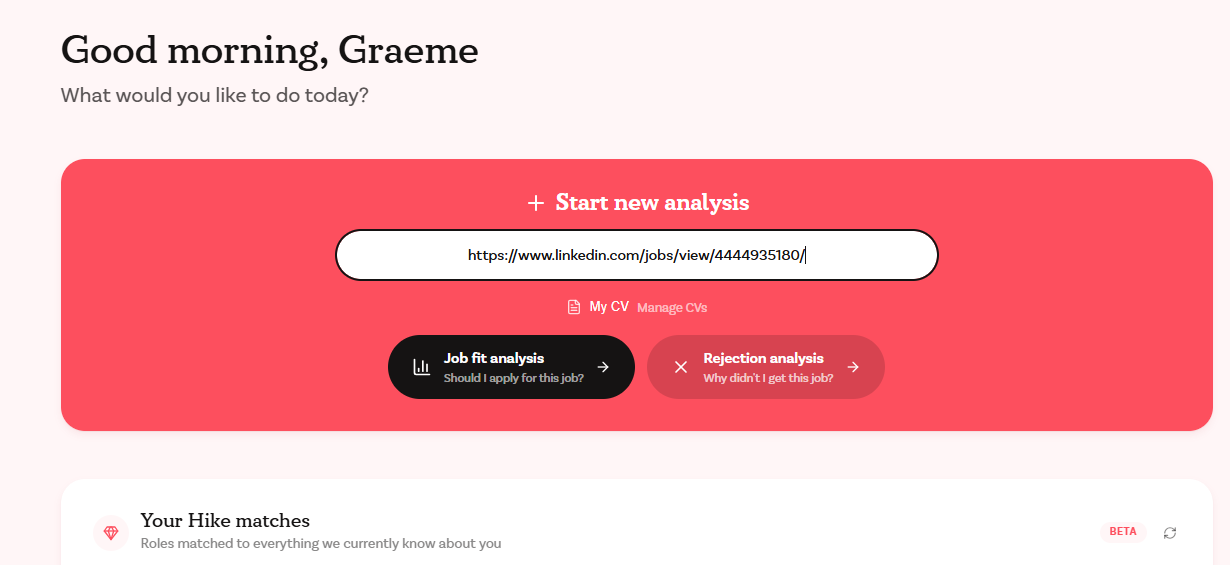
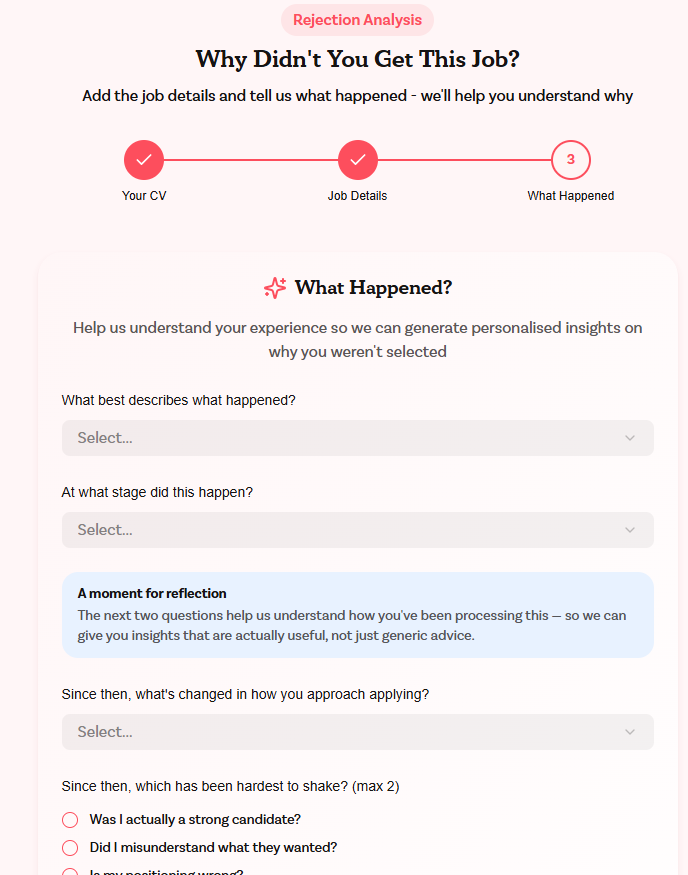
- We'll ask a couple of follow-up questions to help shape the analysis
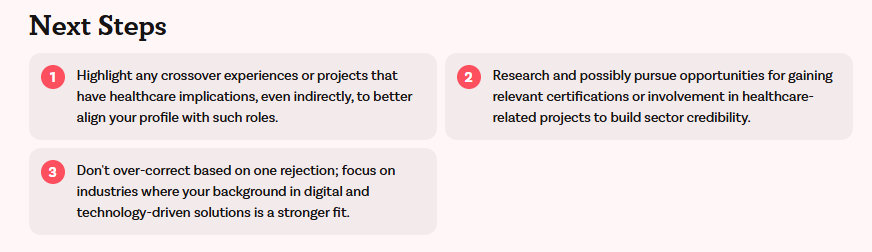
- We'll do some digging and come back with where we think there was a mismatch or some internal intricacies that might have come in to play. And we'll try to point you in the right direction for what comes next.
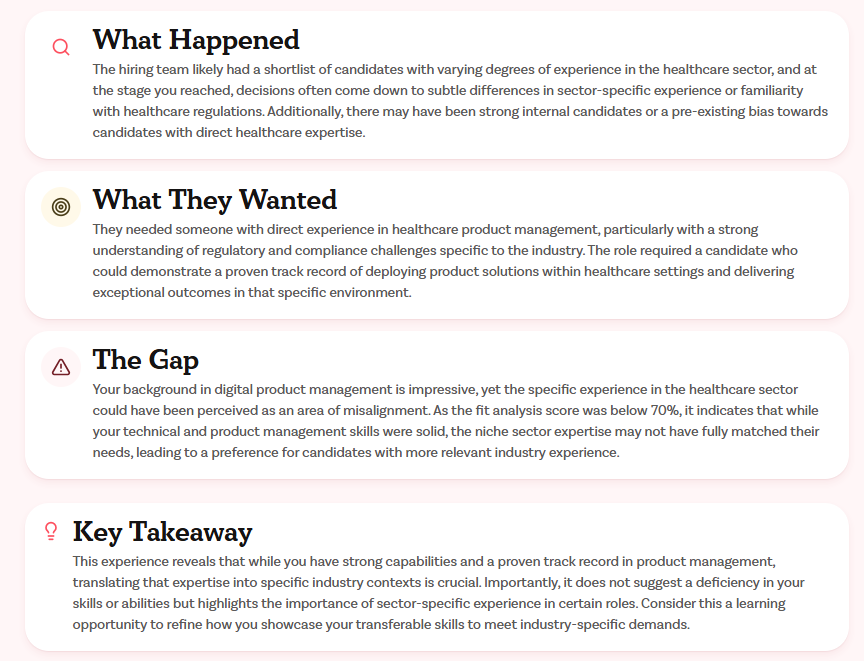
So, what actually is Rejection Analysis?
When you receive a rejection, or when a role simply goes quiet, you can bring it to Hike. Drop in the URL of the job and paste the rejection email if you have one. Add context about the role, the stage you reached, and what you know about how the process went and then we analyse it.
The output isn't generic feedback. It's a structured, honest read of what likely happened and what, if anything, you can do about it.
What Hike Looks For
A rejection email contains more information than it appears to. The language used, what it does and doesn't mention, the stage at which it came are all signals. Hike combines them with what it knows about the role you applied for and your profile, to reconstruct a likely account of what drove the outcome.
There are broadly four categories of rejection reason and Hike identifies which is most likely in play:
1. Fit mismatch
Your profile was a genuine stretch for the role. The experience, seniority, or sector alignment wasn't close enough for you to make the shortlist against stronger candidates. This is the most common reason, and also the most actionable because it tells you something concrete about the gap to close.
2. Application quality
You were a realistic candidate, but your CV or cover letter didn't make the case compellingly enough. The evidence was there; the articulation wasn't. This is also highly fixable and often the culprit when people who should be getting interviews aren't.
3. Process factors
The role was filled internally. The headcount was frozen. The hiring manager changed. A candidate with a specific connection got the role. These things happen, and they have nothing to do with your suitability. Hike helps you identify when this is a likely explanation so you don't spend time "fixing" something that wasn't broken.
4. Bias signals
This is the hardest one to talk about, but one of the most important. Research consistently shows that CVs with names, educational backgrounds, or other markers associated with protected characteristics receive fewer callbacks - even when the underlying experience is identical. Hike flags when your rejection pattern is consistent with bias and shows you the specific signals in your materials that may be contributing.
Reflective, Not Generic
The thing that distinguishes Rejection Analysis from standard feedback, or from the kind of advice you'd find in a LinkedIn post about "why you're not getting interviews", is that it's grounded in your specific situation.
It doesn't start from a template and fill in your name. It starts from what you applied for, what you brought to the table, what stage you reached, and what the rejection said. Your analysis reflects that specific combination.
This matters because generic advice is often actively misleading. "Make your CV more concise" is good advice for some people and terrible advice for others. "Highlight your leadership experience" is useful if you have leadership experience that's currently underplayed and useless if leadership experience is what you're genuinely short of.
We'll tell you what's actually true about your situation. Even when that's harder to hear.
Pattern Recognition Across Rejections
One rejection is a data point. Three rejections tell a story.
As you log more applications and rejections in Hike, patterns emerge. You might discover that you're consistently getting through to first-stage interviews but losing out at panel stage, which suggests an interview preparation problem rather than a CV problem. You might find that your fit score for every rejected role was below 65%, which suggests your target role definition needs recalibrating. You might find that all your rejections are coming from roles at a particular seniority level, which might mean you're consistently pitching slightly above where your evidence currently sits.
These patterns are genuinely difficult to see when you're inside the process. Hike surfaces them from outside.
What Hike Won't Do
Rejection Analysis is not a comfort machine. We don't tell you the company was wrong, or that you were clearly the best candidate, or that their loss is someone else's gain.
Sometimes the honest answer is: you weren't the right fit for this one and here's exactly why. That's more useful than reassurance, even if it's harder to receive.
We also won't invent an actionable insight where there isn't one. If the most likely explanation is a process factor outside your control, an internal hire - a headcount freeze, a decision made before the process started - we'll say that, and we'll help you focus your energy on the applications where your actions genuinely make a difference.
Rejection as Intelligence
The job market is opaque by design. Hiring processes reveal almost nothing about why candidates succeed or fail. This information asymmetry consistently advantages people who already have strong networks; people who know someone who can tell them what really happened, who can get informal feedback, who can find out what the winning candidate looked like.
Rejection Analysis is Hike's attempt to close that gap. To take the silence that most candidates receive and turn it into something you can actually act on.
You deserve to know why. Even when the why is uncomfortable.